Two announcements from DAIS 2026 show how improvements to the data layer can make AI agents faster and more capable, without touching the agent code itself: LTAP and Lakehouse//RT. In the following, we will go into details of those new changes/technologies and show how they can improve Agents’ capabilities. We will use an example that Cavallo Technologies implemented recently at a client: an enterprise supervisor agent that uses multiple sub-agents like Genie Spaces, RAG systems, plotting and web searching capabilities.
Lakehouse//RT: faster reads for agents
When an AI agent runs an analytical query mid-conversation, every second of wait time affects the user experience. Most analytical queries on a standard SQL warehouse take several seconds, which is fine for a scheduled report but noticeable in a live conversation.
Lakehouse//RT, powered by Reyden engine, addresses this directly. Reyden is a full database engine, built completely from scratch. Instead of being optimized for one workload type, Databricks built a factory of engines. Using a decade of production traces (zettabytes of query data from trillions of real executions), they continuously train machine learning models that pick the right execution approach for each query. On standard analytical benchmarks, it delivers sub-100ms query latency at 12,000 queries per second, directly on existing Delta and Iceberg tables in Unity Catalog.
One example from the Databricks blog that is relevant for agent use cases is from Cisco. They are already seeing 5x faster response times querying live data directly from their governed Lakehouse for threat lookup workloads, across both users and agents.
In our Cavallo client example, using Lakehouse//RT as the backbone of the Genie Spaces will significantly reduce the latency of the Genie Spaces sub-agent call, especially for high-volume like IoT sensor data. This is particularly important as the agent can trigger calls to several Genie Spaces to answer a single question, thus compounding the latency gains.
Moreover, since Lakehouse//RT queries data directly in Unity Catalog, all existing governance policies and data access controls apply automatically. The compute size can also be set to auto, so it scales with query load.
LTAP: real-time data access for agent systems
AI agent systems generate a lot of transactional writes: the agent writes conversation turns and decisions, users submit feedback. The problem is that this data typically lands in an OLTP system and must wait for a CDC or ETL pipeline to sync before it is available for analysis. That delay means the agent and your monitoring dashboard are always working with outdated data.
LTAP (Lake Transactional/Analytical Processing) removes that pipeline entirely. The moment data is written; it is available to query. This also means the agent can read operational data directly from the transactional layer. If a user just updated their account or placed an order seconds ago, the agent sees it immediately without waiting for a pipeline to sync.
In addition, when the agent writes an intermediate result or a computed summary mid-conversation, that data is immediately available in the next step. The same applies to user feedback. It lands in the Lakehouse and is immediately available for your monitoring dashboard.
What changes under the hood:
The AI agent code is the same, but what changes is the data layer it sits on top of. The diagrams below show the before and after.
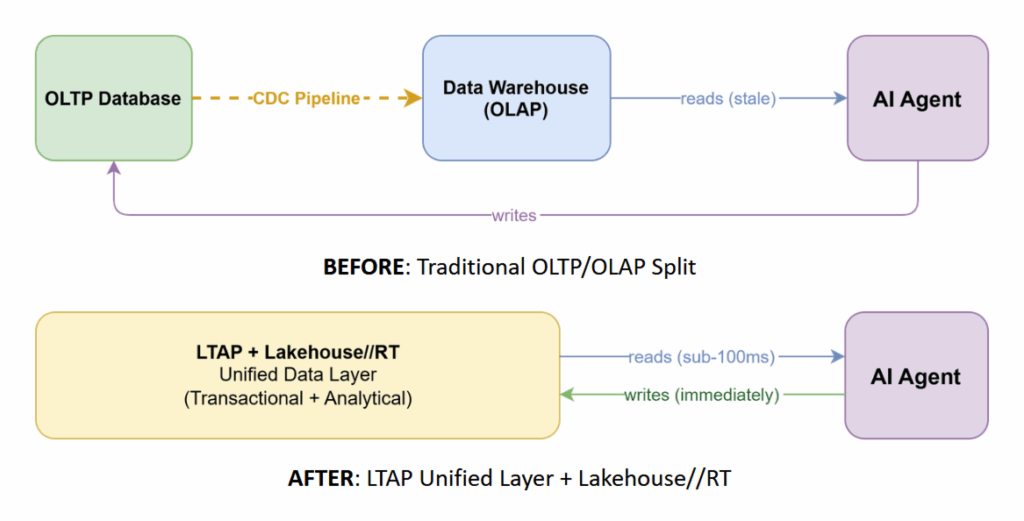
With both features working together:
- Agent queries live operational data. Lakehouse//RT returns results in under 100ms.
- Agent writes an intermediate result mid-conversation. LTAP makes it immediately available in the next step.
- User submits feedback. It lands in the lake instantly and the monitoring dashboard picks it up in real time.
For our client supervisor agent example, the IoT data in the Lakehouse is currently refreshed every 40min. Switching to LTAP would allow the IoT data to be available for queries as soon as they land, allowing the Genie Spaces – and the overarching agent – to access up to date data., Lakehouse//RT lets the agent query faster, reducing waiting time in conversations. LTAP gives the agent and the broader system access to real-time operational data the moment it is written.
Availability
Lakehouse//RT is in Beta now, available to select few customers and will be rolling out more broadly over the next few weeks and months.
LTAP has been announced and coming soon.
Cavallo Technologies
At Cavallo, a Databricks-exclusive firm, we help enterprise teams design and build production AI systems on Databricks. If your team is working on this, we will be happy to dig into the architecture with you.
References
- Lakehouse//RT: https://www.databricks.com/blog/introducing-lakehousert-real-time-performance-unified-lakehouse
- Under the Hood of Lakehouse//RT: https://www.databricks.com/dataaisummit/session/under-hood-lakehousert